The Human Touch vs. The Algorithm: What Happens When AI Comes for Professional Photo Retouchers
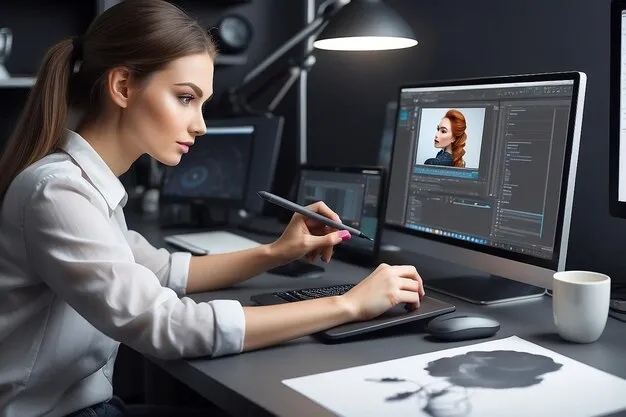
Photo: professional photo editor working on retouching portrait on computer with stylus tablet, via img.freepik.com
A few years ago, if a fashion brand wanted a campaign image with perfectly smooth skin, seamless background removal, and natural-looking frequency separation, they'd hire a retoucher. That work — painstaking, detail-intensive, billed by the hour — was a specialized craft. Today, a halfway decent AI tool can produce a version of that same result in under 60 seconds, for about the price of a monthly streaming subscription.
If you're a professional retoucher, that sentence probably landed like a punch to the stomach. And yet — the story is more complicated than "AI wins, humans lose." We dug into what's actually happening inside this industry.
The Tasks AI Has Already Claimed
Let's be direct about what AI-powered tools are genuinely good at now, because sugarcoating it doesn't help anyone.
Background removal? Done. Tools like Adobe's AI-powered Generative Fill and apps like Remove.bg handle this with a speed and accuracy that would've seemed like magic five years ago. Basic skin retouching — smoothing texture, reducing redness, evening out tone — is now table stakes for any AI beauty tool worth downloading. Teeth whitening, eye brightening, stray hair cleanup: all largely automated.
For retouchers whose bread and butter was this kind of volume work — the e-commerce product shots, the headshot touch-ups, the real estate photo edits — the market compression has been real and fast. "I used to have a client that sent me 200 product images a week," says Maya Delacroix, a freelance retoucher based in Los Angeles. "They switched to an AI workflow about eighteen months ago. I get maybe 20 images from them now, and only the ones the AI messes up."
That pattern — AI handling the bulk, humans catching the failures — is showing up across the industry.
Where the Algorithm Still Stumbles
Here's where it gets interesting, though. For all its speed, current AI retouching has some well-documented blind spots that professional retouchers are quick to point out.
Complex light interaction is a big one. When you're editing a portrait where the subject is lit by three different sources — say, a window, a strobe, and a reflector — the way shadows fall across skin texture is incredibly nuanced. AI tools frequently flatten this complexity in ways that look "clean" at a glance but feel wrong to a trained eye. The skin looks processed rather than lit.
Preserving identity is another sticking point. High-end retouching for editorial or celebrity work requires keeping the subject recognizable while still achieving the desired look. AI tools, trained on broad datasets, have a tendency to drift toward a kind of averaged-out attractiveness — subtly reshaping features in ways that can make different subjects start to look eerily similar. Retouchers call this the "AI face" problem, and it's a legitimate concern for clients who need to maintain a specific person's likeness.
Then there's artistic intent. A retoucher working with a photographer like Annie Leibovitz or Tyler Mitchell isn't just cleaning up images — they're an extension of a creative vision. Understanding what a particular photographer is trying to say, and making editing decisions that serve that vision rather than defaulting to conventional beauty standards, requires contextual intelligence that current AI simply doesn't have.
The Skills That Are Holding Their Value
Talk to retouchers who are staying busy, and a few themes emerge consistently about where they're focusing their energy.
Dodging and burning — the manual process of selectively lightening and darkening areas of an image to create depth and dimension — remains a highly valued skill. AI can approximate it, but the results often lack the intentionality that experienced retouchers bring. "A good dodge and burn takes an okay photo and makes it feel three-dimensional," says Marcus Webb, a New York-based retoucher who works primarily with magazine clients. "The AI version usually just looks like someone turned up the contrast slider."
Color grading and tonal work is another area where human expertise commands a premium. Getting a consistent, intentional color palette across an entire campaign — accounting for different shooting conditions, different subjects, different wardrobe choices — is genuinely hard. AI tools are improving here, but they're still inconsistent in ways that matter at the professional level.
Compositing — merging multiple images seamlessly — remains largely a human domain for complex work. Dropping a subject into a new background and making it look like they were actually there, with matching light and shadow and atmospheric perspective, is the kind of work that requires both technical skill and visual judgment.
The Pivot: Retouchers Becoming AI Wranglers
Perhaps the most interesting adaptation happening in the industry is retouchers repositioning themselves not as alternatives to AI, but as experts in working with it.
Some are building workflows where AI handles the first pass and they handle the refinement — dramatically increasing their output capacity without sacrificing quality. Others are moving into AI prompt engineering and workflow consulting, helping photography studios set up efficient AI-assisted pipelines. A few are focusing on teaching, offering courses and workshops specifically for photographers who want to use AI tools more effectively.
"I think of it like what happened with desktop publishing," says Delacroix. "When Photoshop came out, a lot of people in the darkroom industry panicked. But the ones who learned the software became the most valuable people in the room. Same thing is happening now."
What This Means for the Apps Themselves
From a product standpoint, this tension is actually shaping how AI retouching tools are being developed. The more sophisticated platforms are increasingly building in what you might call "intentionality controls" — ways for users to dial in specific looks rather than just applying a blanket enhancement. The goal is to give the AI enough direction that it can replicate the judgment of a skilled human retoucher, rather than just averaging toward generic attractiveness.
Whether that's achievable — and how long it takes — is one of the more interesting open questions in photo tech right now.
The Verdict
AI has genuinely disrupted professional retouching, and pretending otherwise would be doing a disservice to the people navigating that reality right now. Volume work is largely gone for many practitioners, and the market rate for standard retouching tasks has compressed significantly.
But the craft isn't dead. The retouchers who understand what AI can and can't do — and who've built skills in the areas where human judgment still matters — are finding ways to stay relevant and, in some cases, to thrive. The algorithm is fast and cheap. It's not yet wise.
For now, the best work still has a human fingerprint somewhere in it. The question is how long that remains true — and whether the industry will notice when it stops.